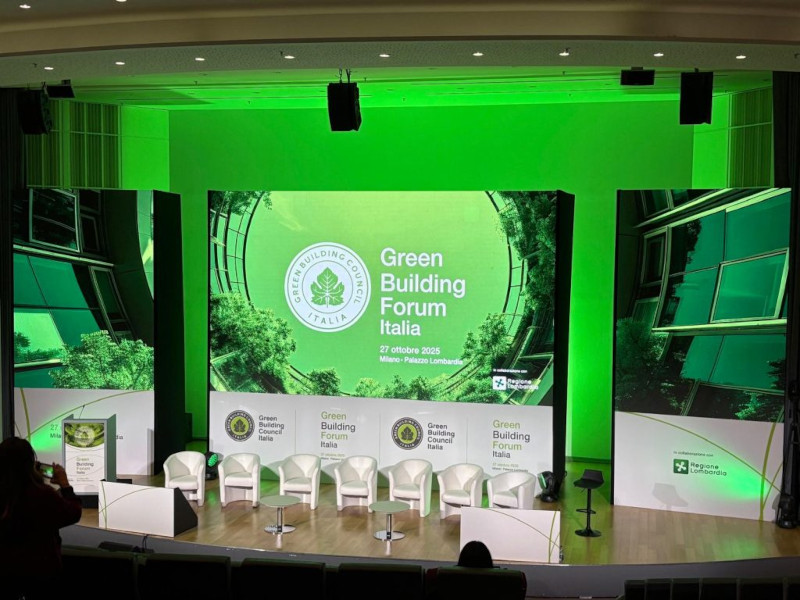
Environmental accountability is now a core criterion in venue selection
Environmental performance has become a decisive factor in professional event planning, and sustainability is increasingly embedded in infrastructure, energy systems, procurement policies, and waste management processes.
Choosing an eco-sustainable venue is therefore a strategic decision that affects costs, logistics, reputation, and long-term organisational positioning.

Eco-sustainable venues as a strategic planning tool
Sustainability has shifted from a reputational preference to an operational requirement. Venue selection directly influences energy consumption, emissions, transport planning, and material use. Facilities designed around environmental performance reduce complexity across the planning process by limiting inefficiencies at the source.
Reputation also plays a significant role, as stakeholders increasingly expect consistency between public commitments and practical decisions. Selecting a sustainable venue provides tangible evidence of alignment between declared values and operational behaviour. This form of credibility often carries more weight than promotional messaging.

Operational efficiency through environmental design
Eco-sustainable venues differ structurally from conventional event spaces. Their design integrates efficiency across multiple systems, including lighting, climate control, water management, and waste handling. These features reduce environmental impact while stabilising operational costs.
Buildings with recognised sustainability certifications consistently demonstrate lower energy consumption and more efficient resource management than traditional facilities. Reduced variability in utility use translates into more predictable budgeting and fewer logistical adjustments during event delivery.

Verified standards and measurable credibility
Certification systems provide independent verification of environmental performance. This distinction is critical, as sustainability claims without monitoring or external validation offer limited practical value.
LEED certification assesses buildings according to energy efficiency, water use, and resource management. Venues that meet these standards operate within structures designed to minimise environmental impact across their lifecycle.

ISO 20121 applies specifically to event management. It establishes procedures to identify environmental, social, and economic effects while improving operational performance. The framework supports continuous monitoring and documented improvement.

Carbon footprint measurement and professional support
Quantifying environmental impact has become an integral part of responsible event planning. Carbon footprint analysis examines emissions generated by travel, energy consumption, materials, and logistics. This information allows organisers to identify reduction opportunities and evaluate trade-offs with precision.
Companies benefit from carbon footprint calculation tools and from professional green consultancy services that support the implementation of concrete mitigation strategies.

This type of technical support transforms sustainability from a general commitment into a structured management process grounded in measurable outcomes.
Participant perception and experiential quality
Environmental coherence influences how events are experienced and evaluated by attendees. Sustainable venues shape perception through operational details such as locally sourced catering, reduced single-use materials, and efficient transport planning. Spatial design often reflects resource awareness, which affects how environments feel and function.

A decision that shapes long-term positioning
Selecting an eco-sustainable venue affects operational efficiency, public credibility, aligns measurable performance with institutional commitments and introduces structured environmental management into event planning.
Global energy and emissions data continue to highlight the importance of reducing resource consumption across all sectors. Building operations account for a significant share of worldwide energy demand, reinforcing the relevance of efficient infrastructure in large-scale activities such as events.
Venue selection has therefore evolved into a strategic decision with long-term implications. Organisations that prioritise environmental performance position themselves more clearly within a landscape where sustainability is increasingly monitored, measured, and expected.